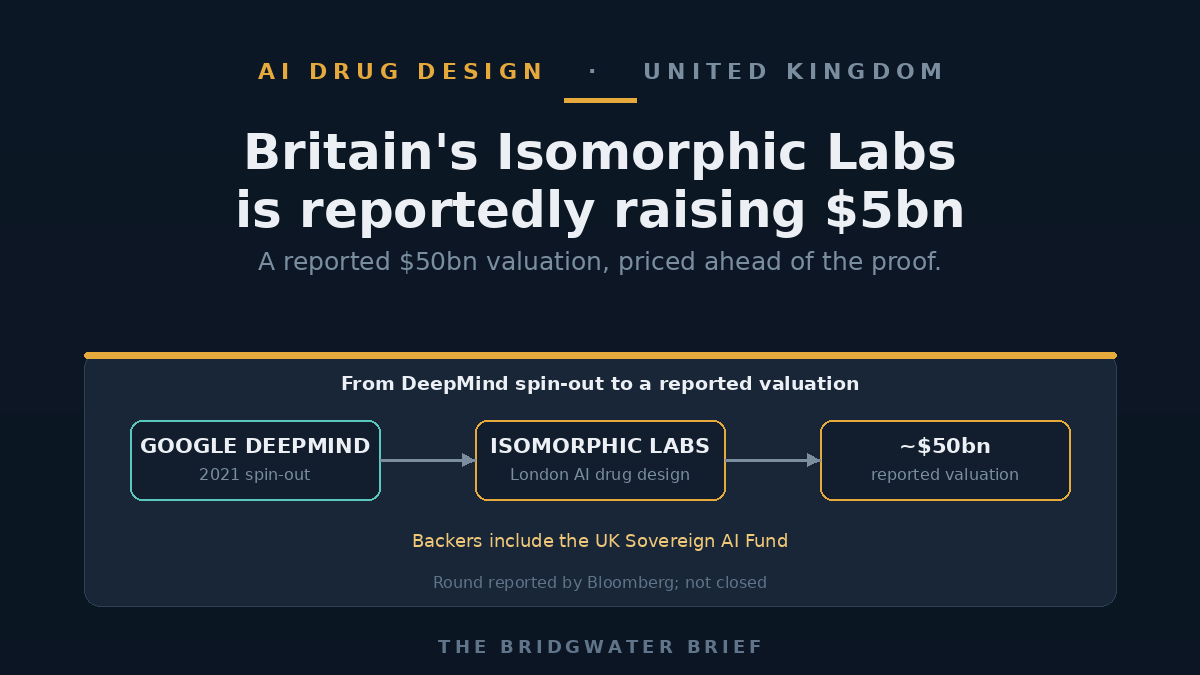
Isomorphic Labs, the London-based AI drug-design company spun out of Google DeepMind, is in talks to raise around $5bn (about £3.75bn) at a valuation of roughly $50bn, according to reporting by Bloomberg picked up by trade press on 5 and 6 November. If it completes on the terms described, it would make Isomorphic one of Britain's most valuable private technology companies. Two things keep the story honest. The round is not closed: the figures are Bloomberg's, attributed to people familiar with the talks, and the terms may change. And the company, for all its promise, has not yet put a single drug into a human trial. This is a very large bet on what AI-designed medicine might do, priced well ahead of the proof.
This piece reflects reporting as of November 2026. The round is reported, not confirmed, and the figures may change.
What was actually reported
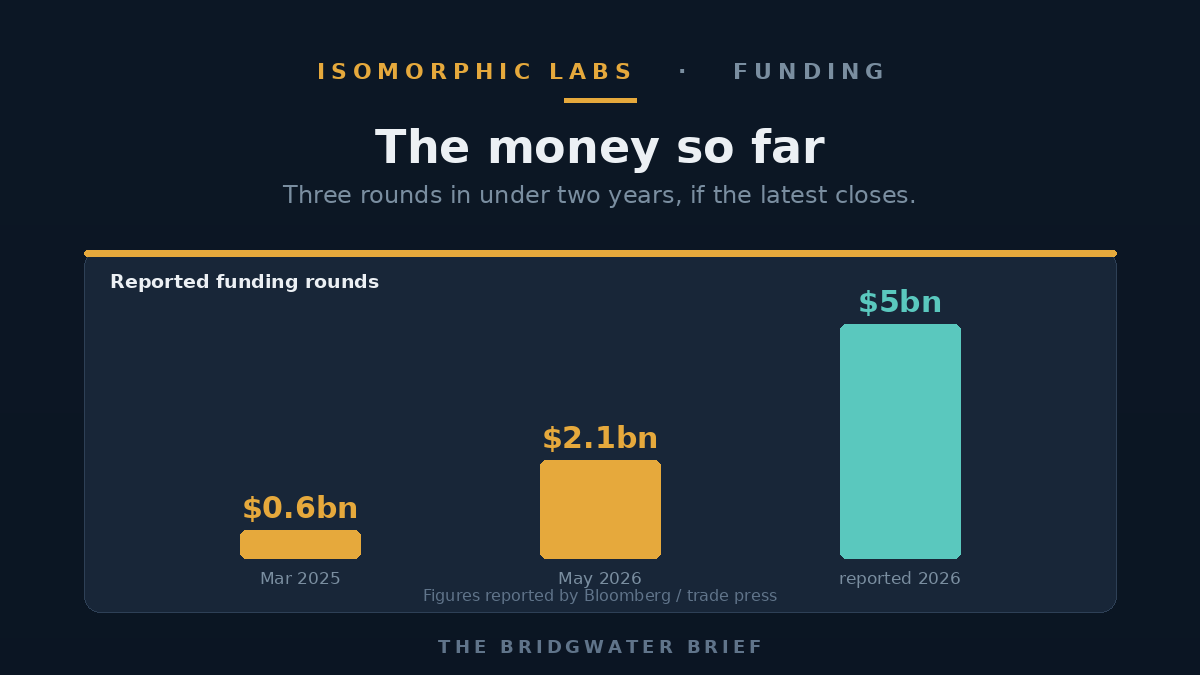
Bloomberg reported that Isomorphic is in talks for a fresh funding round of about $5bn that could value it near $50bn, a step up from earlier discussions that had referenced a figure of $40bn or more. As BusinessCloud noted, that is the valuation "if it completes on currently expected terms", which is reporter's shorthand for a deal that is being negotiated, not signed. Neither Isomorphic nor Alphabet has publicly confirmed the raise. For context, this would follow a roughly $2.1bn Series B that reportedly closed in May 2026 and a $600m first external round in March 2025. Taken together, that is a remarkable amount of capital gathered in under two years by a company whose core product is still, in effect, a scientific wager.
Why this is a British story
Isomorphic was spun out of Google DeepMind in 2021 to build on AlphaFold, the protein-structure work that won DeepMind's researchers a share of the 2024 Nobel Prize in Chemistry. It is run by DeepMind's co-founder Sir Demis Hassabis, and it keeps the bulk of its staff, reported at more than 350 people, in London and Cambridge, with smaller offices in Massachusetts and Lausanne. Its backers are an international roll-call (Thrive, Alphabet, GV, Temasek and others), but the Series B also included the UK Sovereign AI Fund, the government-linked vehicle set up to take stakes in frontier British AI companies. So a large share of the value being discussed here is, for once, being built in Britain rather than bought from it. That matters for a country that has spent the past year watching homegrown AI firms get acquired by American giants.
It also sits in a visible cluster. London has become an unusually dense spot for AI-led drug discovery: we have covered Basecamp Research raising $140m for AI-designed medicines and the two London labs backing a virtual-cell project, Isomorphic among them. A $50bn valuation would make it the giant of that group by a wide margin.
The part the number does not show
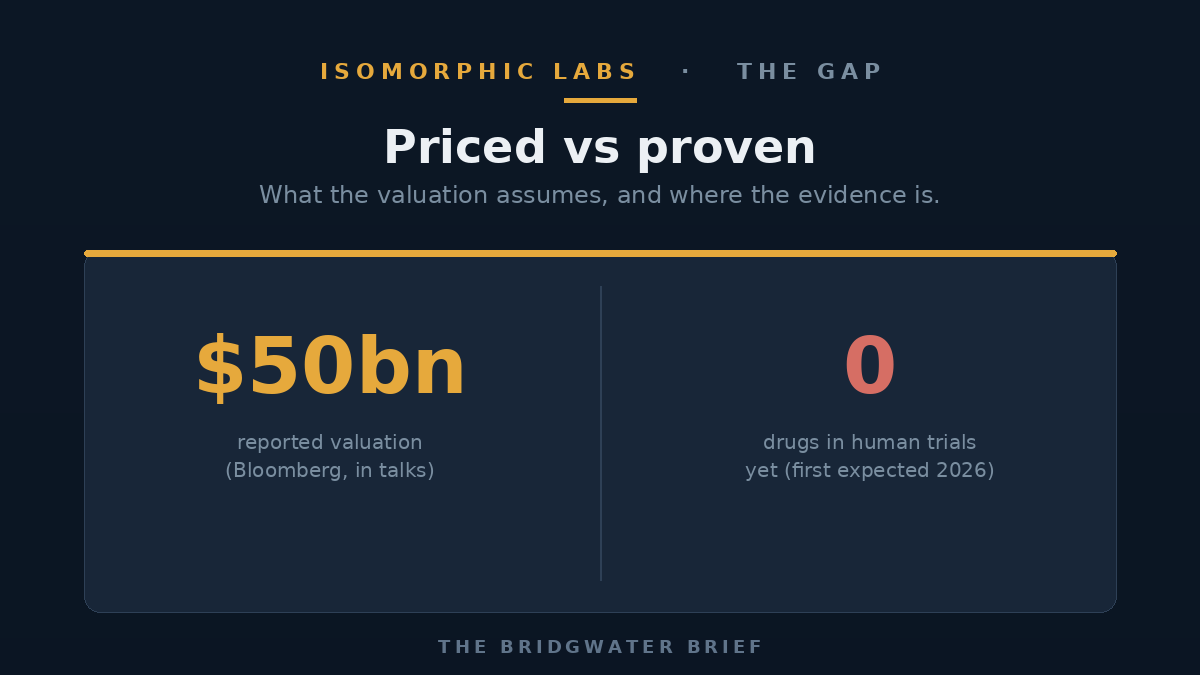
A valuation is a claim about the future, and Isomorphic's future is unusually unproven for the price. The company designs drug candidates with AI and licenses or develops them; it has partnerships with Novartis, Eli Lilly and Johnson & Johnson, with large milestone payments attached. What it does not yet have is a drug that has been tested in a person. Sir Demis has said he expects Isomorphic's first clinical trials to begin before the end of this year, a timeline that has reportedly slipped before. A first trial would be a genuine milestone, but it is worth being clear about what it would and would not show: getting a candidate into human testing demonstrates that the pipeline can produce something trial-ready, not that the drug works. Efficacy and safety take years to establish after that.
So the honest way to read a $50bn tag is as a price on conviction. Investors are betting that AlphaFold-style modelling will compress the slow, expensive early stages of drug discovery, and that Isomorphic is the company most likely to prove it at scale. They may well be right. But by comparison, another AI-biology firm, Chai Discovery, was reported this summer at a $3.8bn valuation; Isomorphic's figure is more than ten times that, for a company that is, on the clinical evidence, at a similar early stage. The gap is the promise.
What it means for readers
For anyone outside the funding round, there is nothing to act on and nothing to buy: Isomorphic is private, and the raise, if it happens, is between the company and a short list of large investors. What it signals is more useful than any single number. It is a marker of how much money is now chasing the idea that AI can redesign how medicines are found, and a reminder that the money is arriving well before the results. For Britain, it is a rare case of a frontier AI company scaling up at home rather than being sold abroad. Whether that turns into drugs on shelves, or an expensive lesson in pricing hope, is the thing to watch over the next few years, starting with whether that first trial actually begins on schedule.
FAQ
Has Isomorphic Labs actually raised $5bn?
Not confirmed. Bloomberg reported that it is in talks to raise about $5bn at a roughly $50bn valuation, citing people familiar with the discussions. The company has not publicly confirmed it, and the reports say the terms are not final.
What does Isomorphic Labs do?
It uses AI, built on DeepMind's AlphaFold protein-structure work, to design drug candidates, then develops them in-house or with pharmaceutical partners such as Novartis, Eli Lilly and Johnson & Johnson. It was spun out of Google DeepMind in 2021 and is run by Sir Demis Hassabis.
Is it a British company?
Yes. It is headquartered in London, keeps most of its staff in London and Cambridge, and its reported Series B included the UK's Sovereign AI Fund alongside international investors. Alphabet, Google's parent, is also a backer.
Has it produced a working drug?
Not yet. It has not reported putting a drug into a human trial. Sir Demis has said he expects the first clinical trials to begin before the end of 2026, a timeline that has reportedly slipped before. A first trial would show the pipeline can reach the clinic, not that any drug is effective.
The takeaway
A reported $50bn valuation for a British AI lab is the kind of number that makes headlines, and it is worth taking seriously: Isomorphic has real science behind it, serious partners, and a rare amount of homegrown ambition. It is also worth keeping in proportion. The round is not closed, the figures are Bloomberg's rather than the company's, and the valuation is priced on what AI-designed medicine might deliver, not on anything a patient has yet taken. The honest question is not how big the raise is, but whether the first clinical trial arrives on time and what it shows when it does.
Sources
- BusinessCloud – DeepMind founder 'to raise £3.75bn for Isomorphic Labs' (6 November 2026)
- Tech Funding News – Report: Isomorphic Labs in talks to raise $5B at $50B valuation (5 November 2026)
- The Bridgwater Brief – London's Basecamp Research raises $140m for AI-designed medicines
- The Bridgwater Brief – Two London AI labs are backing a £1.8bn bet to build a virtual cell