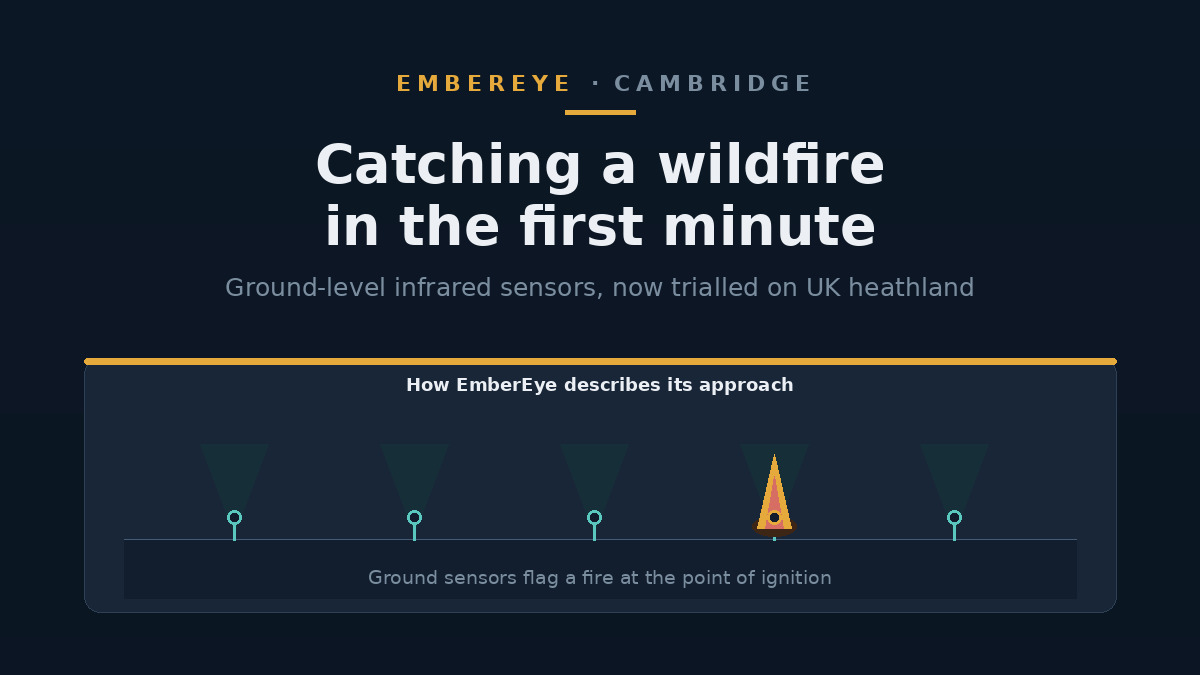
A Cambridge startup called EmberEye is trialling ground-level infrared sensors that it says can spot a wildfire within the first minute of ignition, long before the tower cameras and satellites most systems rely on. Its first UK deployment is already running on Ministry of Defence heathland in Surrey, an 18-month trial led with Surrey Wildlife Trust and Surrey Fire and Rescue Service. It is a genuine piece of British deep-tech on a beat most outlets ignore, and the company lists real UK pilot partners, from the National Trust to the Ministry of Defence. The caution to hold onto is that the sharpest claims, including a field trial where EmberEye says it beat an existing camera system, are the company's own and have not been independently published.
This piece reflects reporting as of October 2026. Performance figures are the company's own and have not been independently verified.
What EmberEye actually does
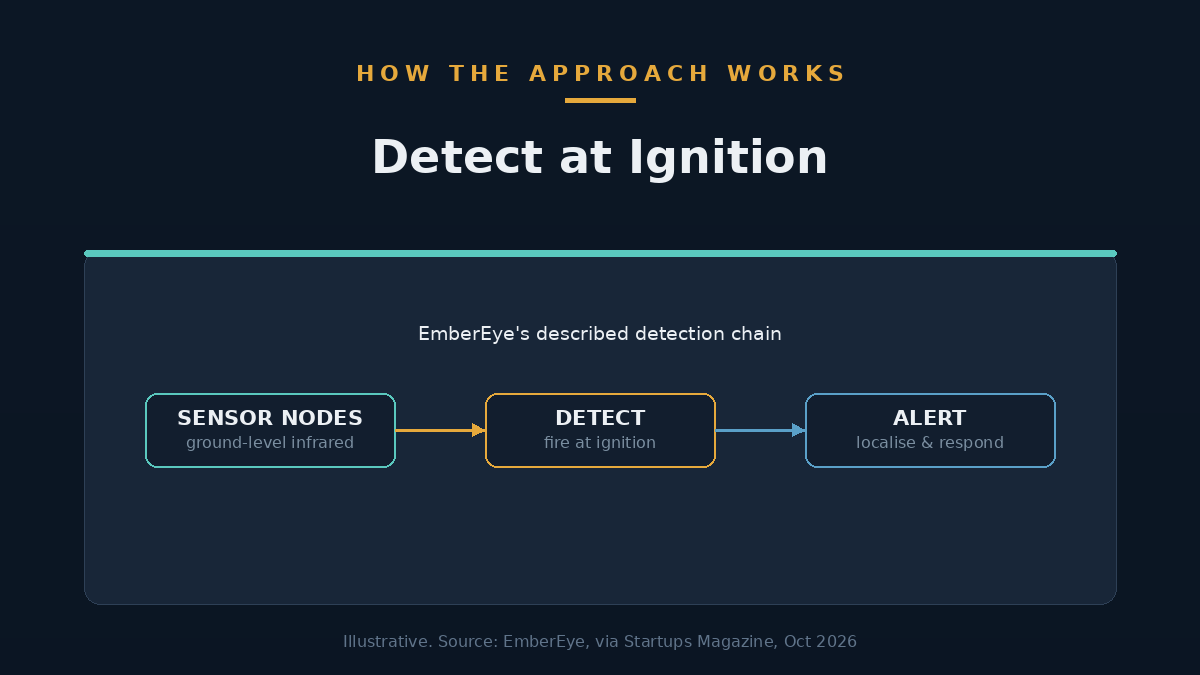
Most wildfire detection today leans on cameras mounted on towers and on satellites that spot the heat or smoke of a fire once it has grown enough to see from a distance, the kind of satellite approach we covered with the FireSat programme. EmberEye's pitch is to work closer to the ground. It places a network of low-power sensor nodes that use infrared sensing to detect the heat signature of a fire at or near ignition, then uses software to localise it and raise the alarm. The company, profiled through the Cambridge Judge Business School ventures programme, describes the result as continuous monitoring that flags a fire as it starts rather than after it has taken hold. It was founded by electronics engineer Enrico Miraglia Del Giudice and Kyle Nisbet, whose background is in wildfire and remote-sensing data. The practical claim is speed: catch the fire in the minute it is still small, when putting it out is cheap, rather than in the hour when it is not.
The claim to test, and the trial behind it
The headline EmberEye leans on comes from a field trial it says it ran with the Marin County Fire Department and the UC Berkeley Disaster Lab in California. The company says its sensors detected a controlled fire in under a minute, while the area's incumbent camera-based system failed to spot it at all. If that holds up in independent testing, it is a meaningful result. For now it is a company-reported figure from a single demonstration, with no published methodology, so it belongs in the "promising, unverified" column rather than the "proven" one. EmberEye also says it has completed around 20 field demonstrations, and it frames the technology as up to 60 times faster and 10 times cheaper than existing methods, again its own figures. The broad case it rests on, that with wildfire danger speed rather than size is the real threat, is widely accepted among fire-safety bodies; that is not the same as anyone independently verifying EmberEye's own numbers.

Why a UK wildfire startup is not as odd as it sounds
Wildfire still reads as a California or Australia problem to most British readers, but the UK beat is growing. Heathland, moorland and grassland fires have become more frequent in hot, dry spells, and the organisations that manage those landscapes are the ones EmberEye names as early partners: the National Trust, Surrey Wildlife Trust, the City of London Corporation, Surrey Fire and Rescue Service and the Ministry of Defence, which manages large training estates that are prone to fires. That spread of partners is the most useful signal here. It points at a real UK need, and a live trial on MoD land run with a wildlife trust and a fire service is the kind of early validation that is harder to manufacture than a press-release statistic. It is still worth saying plainly that a pilot is not a contract: running a demonstration with an organisation is not the same as that organisation depending on the system.
FAQ
Is EmberEye a tool I can buy?
No. It is sold to public bodies, land managers and infrastructure operators, not to individuals.
Does the "under a minute" detection claim hold up?
Treat it as a company figure for now. It comes from EmberEye's own account of a single field trial, with no independently published methodology, so it is a claim to be tested rather than a verified result.
Has EmberEye raised any funding?
Not that the company has announced. An earlier trade-press report that EmberEye had raised £1.5m was incorrect and has since been withdrawn by the outlet that published it; EmberEye has confirmed no such round took place.
Why does the UK need wildfire detection?
Heathland, moorland and grassland fires have become more common in hot, dry spells, and the land managers EmberEye names as partners, including the National Trust and the Ministry of Defence, manage exactly the kind of sites at risk.
The takeaway
EmberEye is a small but real example of British deep-tech aimed at a specific, physical problem rather than another chatbot. The idea, catching a fire in the minute it starts with cheap ground sensors and AI, is sound, and the list of UK pilot partners is the part that should make a reader take it seriously. The efficiency and trial figures are the company's own and unproven, so the fair verdict is a credible UK startup with a genuine problem to solve and a claim still waiting on independent testing. The next wildfire season, not a press release, is what will show whether it works.
Sources
- Surrey Wildlife Trust – Using tech to keep fire risks in check (names EmberEye; first-hand account of the Elstead Commons trial)
- Cambridge Judge Business School – EmberEye venture profile
- EmberEye – company announcement, 7 October 2026 (press release; link if a public URL exists)
- The Bridgwater Brief – FireSat's new satellites use AI to catch wildfires early (20 July 2026)
Correction, 16 October 2026: an earlier version of this article reported that EmberEye had raised £1.5m, based on a trade-press report that has since been corrected. EmberEye has confirmed no such funding round took place. The funding references have been removed and the article re-focused on the company's field trials.