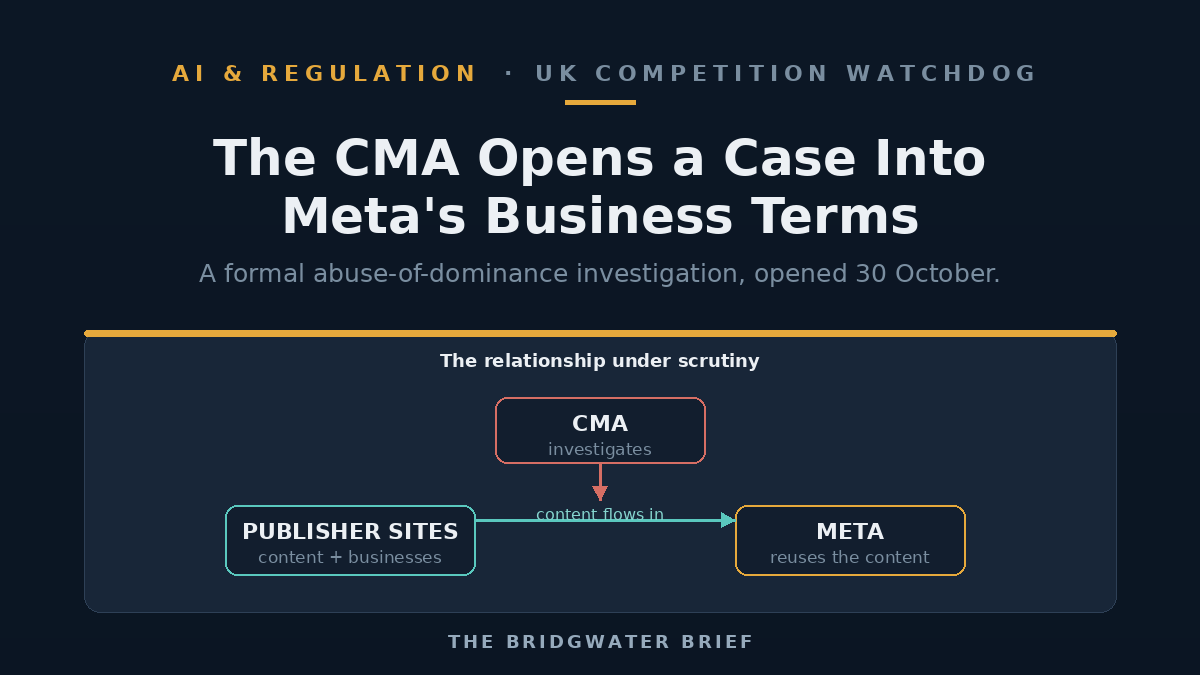
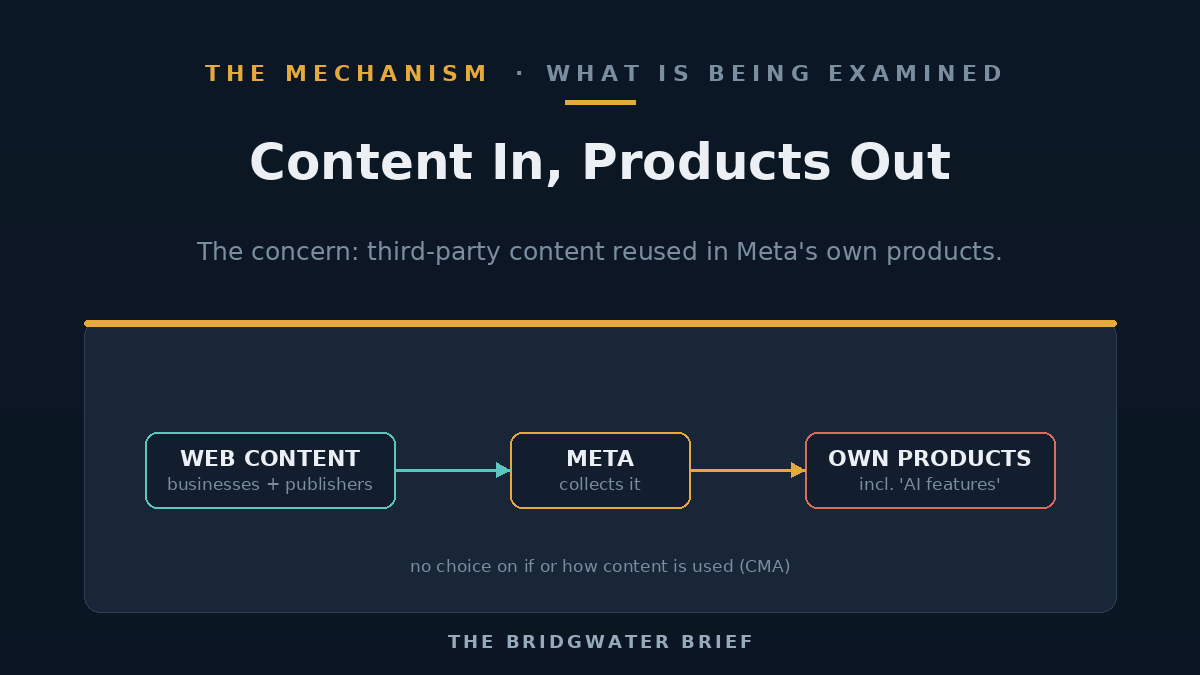
The UK's competition regulator has opened a formal investigation into the Meta business terms this site has covered twice in October. On 30 October the Competition and Markets Authority said it was investigating whether Meta is abusing a dominant position by imposing unfair terms on the publishers and advertisers that use its platforms. Among the CMA's stated concerns is that the terms could let Meta collect content from businesses' and publishers' websites and use it to develop its own products and services, in the regulator's own words "including its AI features", without those businesses getting a choice in how their content is used. No finding has been made, and the route the CMA has chosen is the slower one. But a national regulator formally investigating the exact clause we warned UK businesses about is a real escalation.
This piece reflects reporting as of October 2026. The investigation has only just opened, the dates the CMA has published are indicative, and Meta had not issued a public response to the investigation at the time of writing.
What the CMA has actually done
The CMA has opened a case under Chapter II of the Competition Act 1998, the prohibition on abusing a dominant market position. The businesses named in the case file are Meta Platforms, Inc., Facebook UK Limited and Facebook Ireland Limited, with the investigation possibly reaching other parts of Meta's corporate group. The regulator says it will assess whether Meta holds a dominant position in one or more relevant UK markets and, if so, whether requiring businesses to accept these terms amounts to imposing unfair trading conditions on firms that depend on Meta to reach customers and audiences.
This is an opening, not a verdict. The CMA states plainly that it has made no decision on whether Meta has broken competition law. Its published timetable sets out a period of rapid information-gathering and engagement with Meta and third parties running from October 2026 into January 2027. If the regulator provisionally concludes there is a problem, the next formal step would be a statement of objections; it could also close the case. Sarah Cardell, the CMA's chief executive, said the authority had heard concerns from publishers and other businesses and was "acting swiftly to investigate".
Why this connects to what we reported
Earlier this month we told UK businesses that Meta's new commercial terms would, from 30 October, treat the website linked to a business account as fair game for Meta to crawl and reuse. Days later, after criticism, Meta quietly dropped the word "train" from the clause while the crawling authorisation itself stayed in place. The honest reading at the time was that Meta had softened the label but not the mechanism.
The CMA's concern maps onto that mechanism rather than the label. It is not alleging an "AI-training licence" in those words; it describes a broad right for Meta to collect content from the sites of businesses and publishers and reuse it in its own products, of which AI features are one named example. That framing fits what we found: the worry was never one verb in a sentence, it was a standing right to take other people's content on terms you accept simply by continuing to use the service.
Who brought the complaints, and who is said to be harmed
The CMA says it acted after hearing concerns from the News Media Association, which represents UK news publishers, and the Movement for an Open Web. The harm the regulator describes falls on two groups: news publishers and other content businesses whose material could be reused, and the advertisers and businesses more broadly that rely on Meta's platforms and have little practical choice but to accept its terms. The CMA puts the number of affected UK businesses in the thousands.
That breadth is the point of a competition case, as opposed to a copyright or data-protection one. The question is not only whether reusing a given article is lawful, but whether a firm with few realistic alternatives can impose take-it-or-leave-it conditions on everyone who needs to reach audiences through it. The CMA also says it is separately seeking information from Meta about its "Meta One" business subscription and about Federation of Small Businesses concerns over external links on Facebook and Instagram, though it stresses those sit outside the scope of the investigation opened on 30 October.
The limits worth being honest about
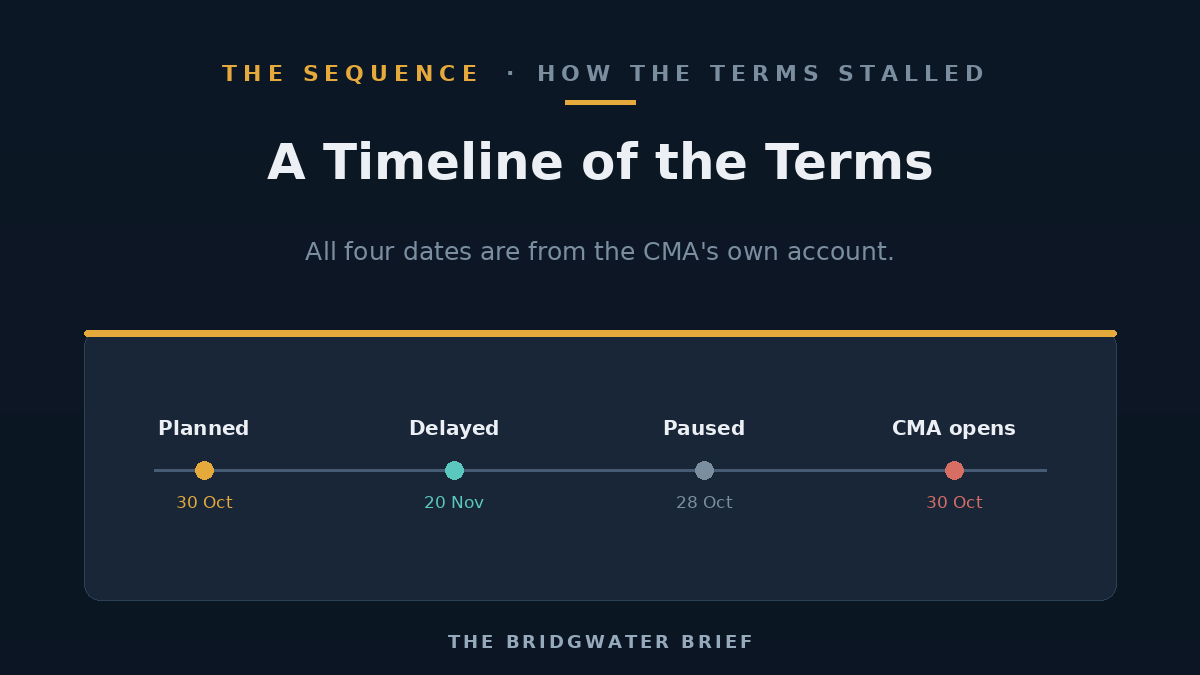
Two caveats matter. First, the terms are not currently live. Meta had planned to introduce the changes on 30 October, delayed them to 20 November after engaging with the CMA, and on 28 October paused the roll-out pending a consultation with industry groups. So the clause UK businesses were bracing for has, for now, stalled, and the investigation runs alongside that pause rather than against a term already in force.
Second, this is the older toolkit. The UK's newer digital-markets regime lets the CMA impose tailored conduct rules on the largest platforms, but only once a company has been designated with "strategic market status", and Meta has not been given that status. The regulator notes its next set of designation proposals is not due before its board until spring 2027. Until then, a Competition Act investigation is the route available, and it is slower, case-by-case, and ends in a finding rather than a standing rulebook.
What a UK business or publisher should take from it
For a publisher, the investigation is a signal that the terms are being contested at the regulatory level rather than only in commentary, but it changes nothing today: there is no order against Meta, and the paused terms could return in amended form. For a business running a Facebook, Instagram or WhatsApp presence, the practical position is the one we described before. The levers you control are your own site's crawler instructions and, at the extreme, detaching a website from the business account, which for many firms means giving up a main customer channel. The CMA case may, in time, change what Meta is allowed to require; it does not hand anyone an opt-out now.
FAQ
Is Meta in trouble with the CMA?
Not yet in any formal sense. The CMA has opened an investigation and made no finding. It will gather information into early 2027 before deciding whether there is a case to answer.
Is this about AI?
Partly. The CMA's core concern is unfair commercial terms, but it explicitly lists Meta using collected content to develop its own products "including its AI features" as one of the things it is worried about. It does not use the phrase "AI training".
Does this stop Meta's new terms?
No. Meta itself paused the roll-out on 28 October pending an industry consultation. The CMA investigation is separate from that pause and does not, on its own, block or permit the terms.
Why not use the new digital-markets powers?
Those powers apply only to firms designated with strategic market status, and Meta has not been designated. The CMA says its next designation proposals are not due until spring 2027, so it is using the Competition Act 1998 instead.
The takeaway
A regulator opening a case is not a ruling, and the terms that prompted it are paused rather than live. But the CMA has put the specific concern we raised, a dominant platform reusing other people's web content on terms they cannot really refuse, onto a formal footing, and named AI features as part of what it is scrutinising. The slow route it has had to take is itself informative: for now, the UK's strongest platform powers do not reach Meta, and a Competition Act investigation is what is left.
Sources
- CMA – press release, "CMA opens investigation into Meta's commercial terms" (30 October 2026)
- CMA – case page, "Suspected abuse of a dominant position in relation to Meta's commercial terms" (opened 30 October 2026)
- The Bridgwater Brief – "Meta will treat your business website as fair game for AI training from 30 October" (16 October 2026)
- The Bridgwater Brief – "Meta cuts the AI-training wording from its new business terms, but the crawling stays" (17 October 2026)