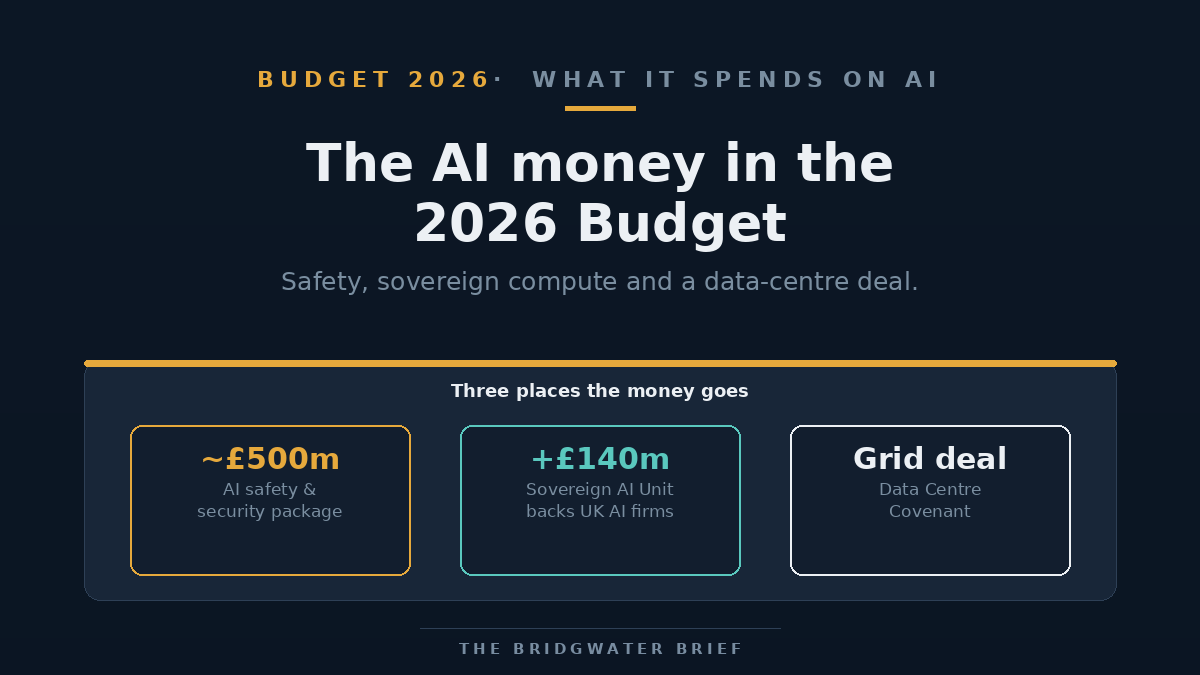
The 2026 Autumn Budget treated artificial intelligence less as a side topic and more as part of the growth plan itself. Alongside the fiscal headlines, the Chancellor set out a package of AI measures: a roughly £500m boost to AI safety and security, an extra £140m for a Sovereign AI Unit meant to back strategically important British AI firms, and a new "Data Centre Covenant" that offers developers priority access to the electricity grid in return for commitments to local communities. There is also a scattering of smaller public-sector AI funds. None of it is transformative on its own, and some of the biggest numbers are headline figures that the Budget document itemises more modestly. But taken together it is the clearest signal yet of where the government wants UK AI policy and money to go.
This piece reflects the Budget as published on 28 October 2026. Figures are drawn from the Budget document and may be revised in supporting Treasury material.
The AI safety money, decoded
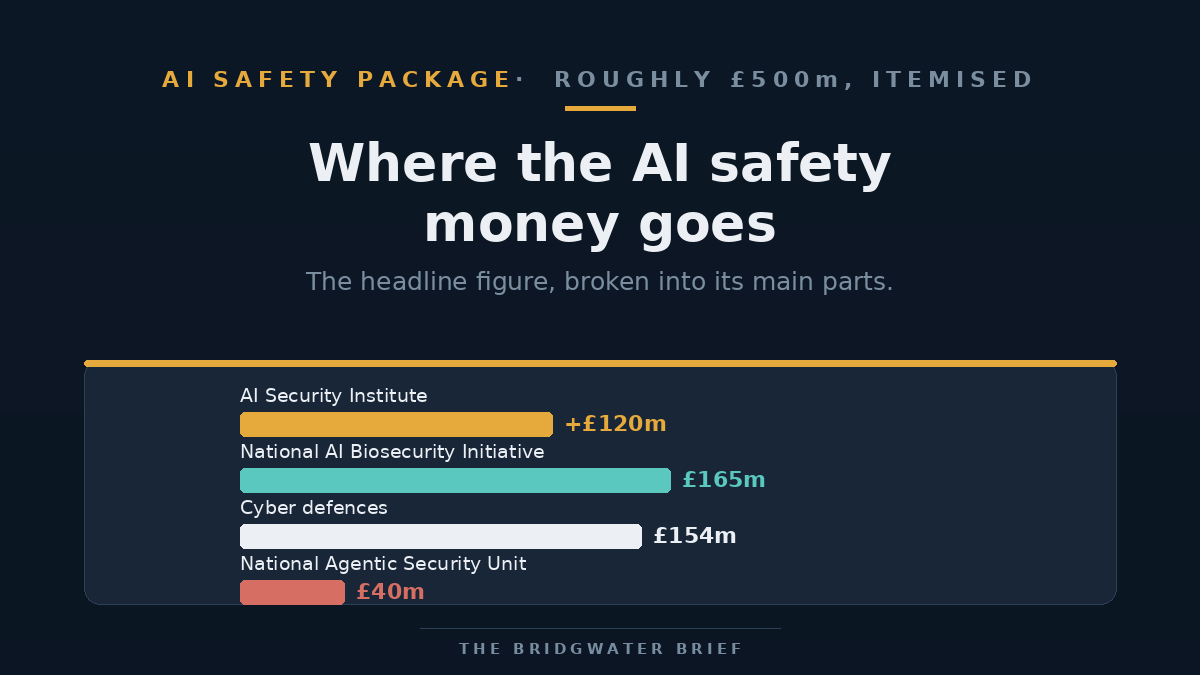
The headline is a boost of around £500m to AI safety and security. That is a single banner over several distinct line items, and the Budget document breaks most of it down: an additional £120m for the AI Security Institute, £165m for a new National AI Biosecurity Initiative, £154m to strengthen cyber defences, and £40m for a new National Agentic Security Unit charged with investigating and responding to what the Budget calls "rogue agentic incidents". That last phrase is worth pausing on: it is the Treasury acknowledging, in a spending line, that autonomous AI agents acting on their own can cause real-world problems the state may have to clean up. Whether £40m buys a meaningful capability or a nameplate is the open question.
Sovereign AI and the data-centre deal
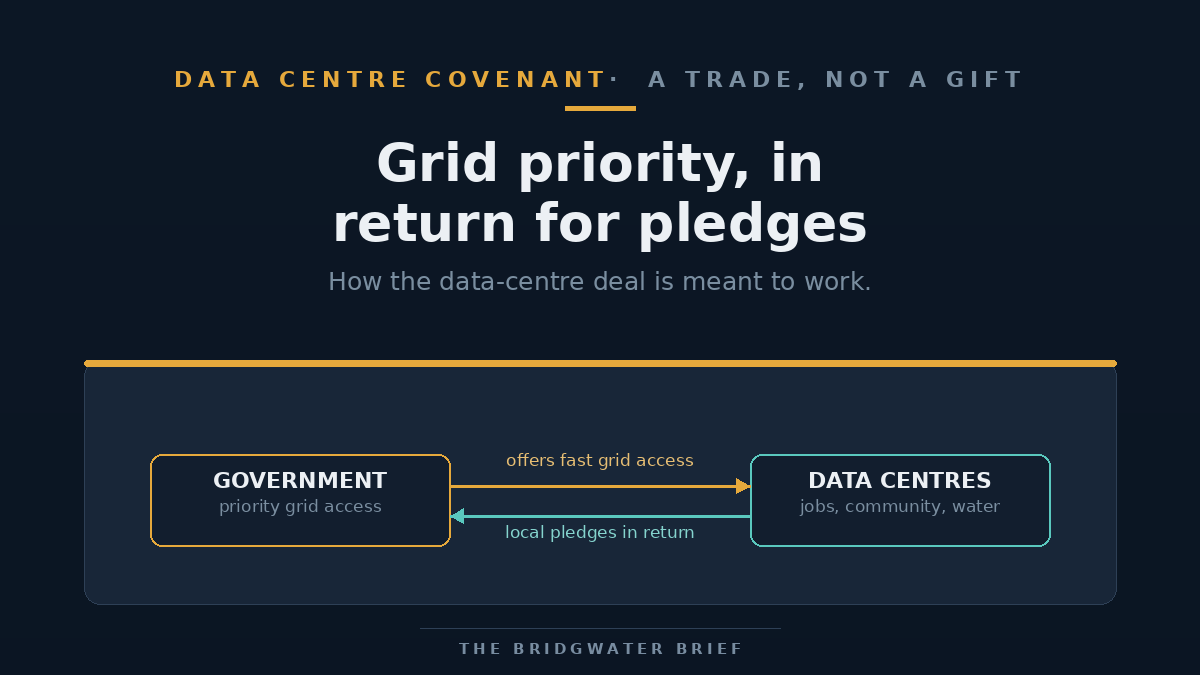
The second strand is about keeping AI capacity, and sensitive data, inside the UK. The Sovereign AI Unit gets an additional £140m to channel investment into British AI companies the government considers strategically important. Sitting alongside it is the British Data Centre Covenant, which the Chancellor framed as a way to ensure "our most sensitive data stays under British control". In practice the covenant is a trade: critical data centres get priority grid connections, and the option to build their own power on site while they wait, in exchange for investing in local communities, creating jobs and protecting local water supplies.
The grid point is not abstract. Building AI data centres in Britain has repeatedly stalled on electricity supply, and Microsoft recently walked away from a planned Essex facility with the firm Nscale over grid-capacity problems. A covenant that fast-tracks connections speaks directly to that. The honest caveat, raised by industry voices on the day, is that investment and infrastructure achieve little for British AI firms unless public bodies actually buy from domestic suppliers, and the Budget does not commit to that shift.
The smaller public-sector AI funds
Below the headline numbers sits a set of measures aimed at getting AI into government itself. The Budget sets aside £35m to set up "GovAI", giving civil servants access to frontier AI tools, and a £50m Civil Service AI transformation fund spread across 2027-28 and 2028-29, paid for from administration savings rather than new money. A £15m AI Challenge Prize, run by DCMS with a top award of up to £2.5m, will be aimed first at the NHS. And a planning tool called PlanAssist is to be offered to all councils in England by the end of 2027, with the stated goal of halving the time routine planning decisions take. One notable absence: the government has cancelled its Digital ID scheme, a reminder that not every government technology plan survives contact with a Budget.
FAQ
Is this a lot of money for AI?
In context, no – these are targeted sums, not a headline "AI superfund". The roughly £500m safety package and the £140m Sovereign AI top-up are additions to existing programmes, and several of the public-sector funds are tens of millions, paid partly from savings. The significance is less the size than the direction: AI safety, sovereign capacity and data-centre grid access all being funded in the same Budget.
What is the "Data Centre Covenant"?
It is a deal for large data-centre developers. In return for priority access to the electricity grid – the thing that has been holding projects up – they must meet conditions on local jobs, community investment and water use. The aim is to get critical AI infrastructure built in the UK rather than lost to other countries.
What is a "rogue agentic incident"?
It is the Budget's own phrase for an AI agent – software that can take actions on its own, not just answer questions – doing something harmful or unintended. The new National Agentic Security Unit, funded at £40m, is meant to investigate and respond to such events. It is an early sign of the state treating autonomous AI as a security issue in its own right.
Does any of this reach ordinary people or businesses?
Indirectly, and over time. The public-sector funds (GovAI, the NHS-focused prize, the PlanAssist planning tool) are where a citizen is most likely to feel the effect, if they work. The data-centre and sovereign-AI measures are infrastructure and industrial policy, whose benefit depends on whether the firms and facilities they support actually materialise in the UK.
The takeaway
The 2026 Budget is the moment AI stopped being a line in a tech strategy document and became a recurring entry in the public accounts: safety, biosecurity, sovereign capacity, agentic risk and data-centre grid access all funded in one go. That matters as a statement of intent. What it does not yet settle is whether the money is enough, whether a £40m unit can police autonomous agents, or whether British AI firms will see any of the benefit without a parallel push to make the state buy from them. Those are the tests worth watching over the next year, not the size of the cheque on Budget day.