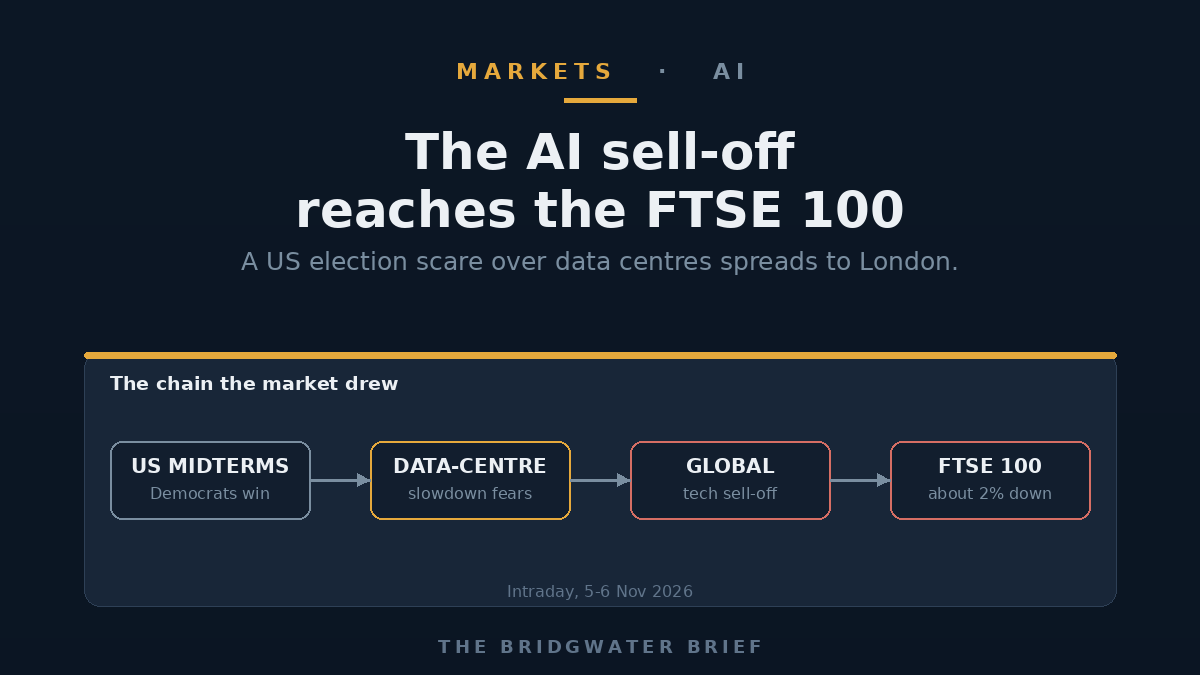
The AI jitters that hit Wall Street this week reached London on 6 November. The FTSE 100 fell about 2% (to 10,540.78 by late morning, its worst session in more than seven months), part of a worldwide drop in technology shares that began after Democrats took control of the US House and Senate in Tuesday's midterms. The market's read, reported by Reuters and others, is that a Democratic Congress means tougher scrutiny of the data centres that underpin AI, and so a slower, costlier build-out. The honest framing matters here: analysts are calling this a swing in sentiment, a "risk-off" reversal, rather than evidence that the underlying AI companies are suddenly worth less. It is a mood, not a verdict, and even the people describing it say it is too early to know if it lasts.
This piece reflects reporting as of 6 November 2026. Market figures quoted are intraday and moved during the session; treat exact percentages as a snapshot.
What actually happened to the markets
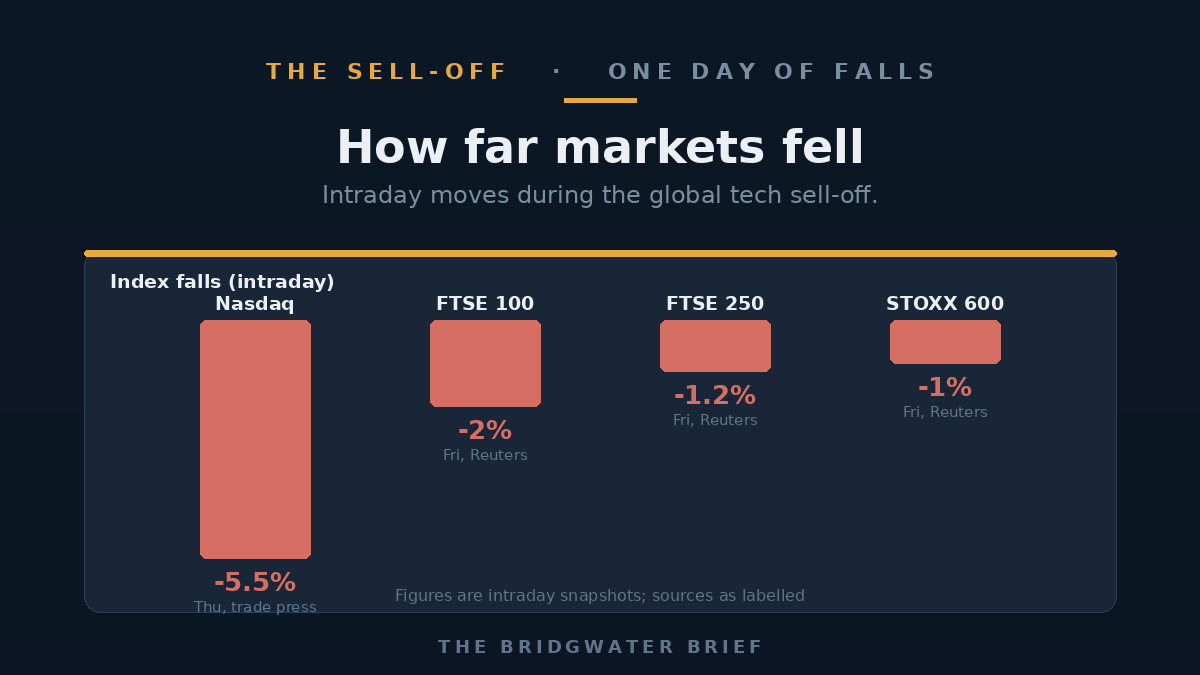
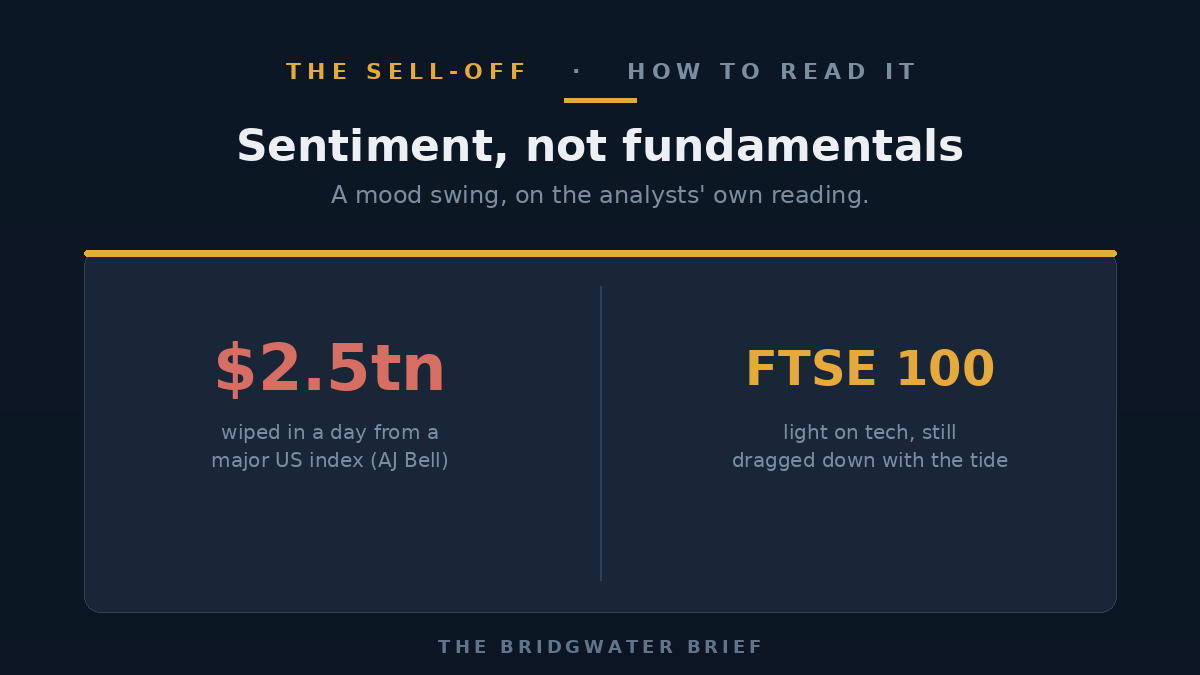
The selling started in the United States. On Thursday, the S&P 500 and the Nasdaq posted their sharpest one-day falls since April 2025, with trade-press reporting putting the Nasdaq down around 5.5%. By Friday the drop had spread: London's FTSE 100 was down roughly 2%, the mid-cap FTSE 250 about 1.2%, and Europe's STOXX 600 around 1%. One widely shared figure, from AJ Bell's Dan Coatsworth, put the value wiped from a single major US index at about $2.5 trillion in a day, though that is one analyst's number and other tallies circulating were lower. Coatsworth's summary was that "it's understandable that investors are feeling on edge". Jason Hollands of Bestinvest was blunter: "Last night's market slide was brutal."
Why a US election moved AI shares
The link runs through data centres. Across the midterms, voters in many US states backed local measures opposing new data-centre construction, the vast, power-hungry buildings that AI models run in, over worries about electricity bills, water use and land. We covered that result in detail when it landed: American voters just rejected data centres, while the UK is accelerating its build-out. With Democrats now controlling both chambers of Congress, investors are pricing in the risk of tougher regulation, slower approvals and the big cloud firms reining in the enormous sums they have been spending on AI infrastructure. Hollands pointed to a Data Center Watch estimate that 45 projects across 27 states were blocked or delayed in a single quarter, representing roughly $68bn of potential investment, though, as he noted, delayed or withdrawn is not the same as cancelled.
There is a second, quieter worry underneath the political one: that enormous amounts are being spent on AI infrastructure while the productivity gains the spending is meant to produce remain, so far, hard to see. The election did not create that unease. It gave it a trigger.
Why the FTSE 100 fell when it barely has the shares
Here is the part that puzzles people. London's blue-chip index is relatively light on technology and AI companies compared with the Nasdaq, or with the markets in Japan and South Korea. So why did it drop at all? Because big sell-offs are rarely tidy. When investors turn cautious, they tend to sell across the board, not just the shares at the centre of the scare, and money flows out of riskier assets everywhere at once. A London index with few AI names can still be pulled along by that global tide. On the day, the falls in London were broad: Reuters reported most sectors sliding, with pharmaceutical, consumer and grocery stocks among the weakest, while precious-metal miners, a traditional safe harbour, edged up.
That breadth is itself a clue to what this is. If the sell-off were a judgement specifically on AI, you would expect it concentrated in AI stocks. A wide, shallow decline across sectors looks more like a general change of mood than a considered re-rating of any one business.
How worried should a UK reader be?
For most people the direct exposure is not the FTSE 100's handful of tech shares; it is the US-heavy global funds inside workplace pensions and ISAs, which hold the American AI giants that fell hardest. A one-day drop, even a sharp one, does not by itself mean much for a long-term pension, and markets that fall fast on sentiment can recover the same way. The more useful point is the honest one the analysts keep making: nobody yet knows whether this is a short-term wobble or the start of a longer reassessment of how much the AI build-out is worth. Hollands framed it as too soon to tell, and noted that lower prices also make shares cheaper, which is as much opportunity as warning. The build-out, on his reading, is not about to stop; the political and local resistance to it is simply now feeding into how investors price the risk.
FAQ
What caused the sell-off?
As analysts and market reporting read it, the immediate trigger was the US midterm results, which handed Democrats control of Congress and raised fears of tougher regulation of AI data centres and a slowdown in the spending that funds them. A fall in US tech shares on Thursday spread worldwide on Friday.
How far did the FTSE 100 fall?
By late morning on 6 November it was down about 2% (to around 10,540 points), reported as its worst session in more than seven months. These are intraday figures and moved during the day.
Does this mean the AI boom is over?
No one is saying that. Analysts describe the move as a swing in sentiment rather than a change in company fundamentals, and say it is too early to tell whether it is a brief wobble or the start of a longer reassessment. The big cloud firms have not announced any halt to their AI spending.
Why did a UK index fall if it has few AI companies?
Because broad sell-offs pull almost everything down together. When investors move out of risk globally, even an index light on tech, like the FTSE 100, gets dragged along. The day's falls in London were spread across most sectors, not just technology.
The takeaway
A 2% fall in the FTSE 100 on the back of a US election is a striking sign of how tightly the whole market is now wired to the AI story, right down to the data centres and the politics around them. But a one-day, sentiment-driven drop is not the same as a reckoning. The figures are still moving, the cause is a change of mood more than a change in the businesses, and the people closest to it are honest that they do not yet know which way it settles. The thing worth watching is not Friday's number but whether the big AI spenders actually slow down, because that, not an election-week wobble, is what would make the scare real.
Sources
- Reuters (via Yahoo Finance) – FTSE 100 tumbles 2% as AI jitters spark global selloff (6 November 2026)
- BusinessCloud – 'Brutal' global tech sell-off spills over to hit FTSE 100 (6 November 2026)
- The Bridgwater Brief – American voters just rejected data centres; the UK is accelerating its build-out
- The Bridgwater Brief – Is the AI data-centre boom pushing up electricity bills?