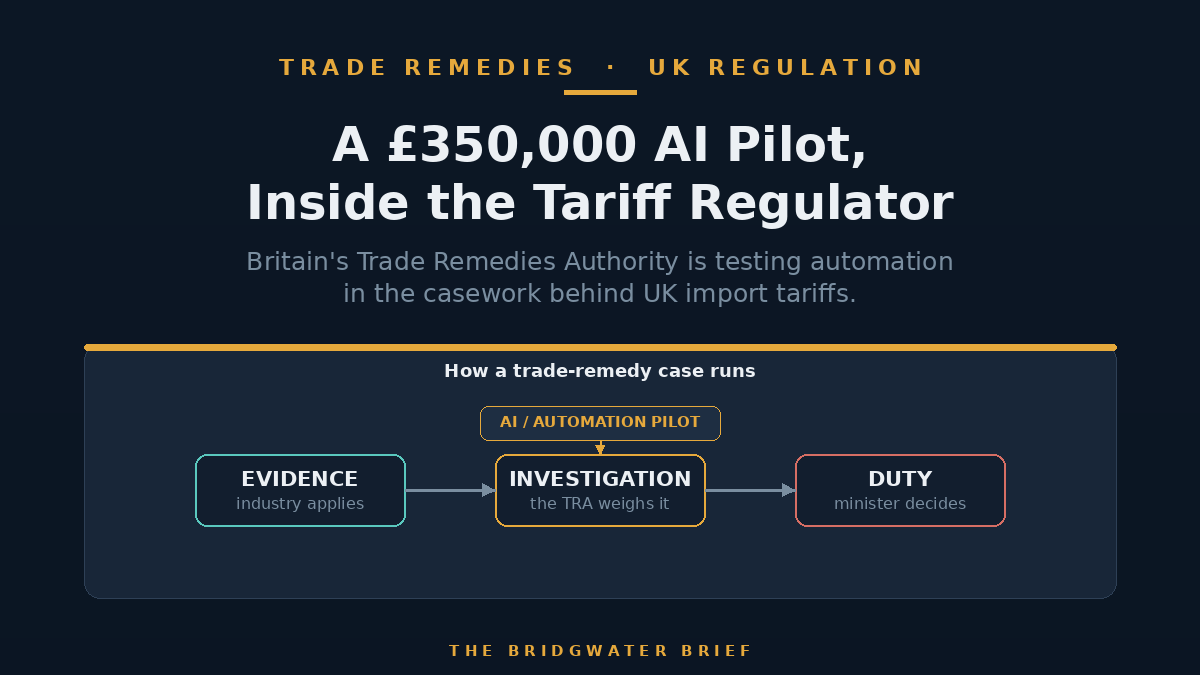
The Trade Remedies Authority (TRA) – the arm's-length body whose investigations lead to the tariffs that shield UK producers from dumped or subsidised imports – has awarded a £350,000 contract for an "Automation and Artificial Intelligence Discovery and Pilot" to work out where AI could take manual effort out of its casework. The award was published on Find a Tender on 4 November 2026, concluded on 19 October, and went to the Leeds consultancy Answer Digital after a competitive process that drew ten bids. The honest bottom line: this is a feasibility study and a prototype, not AI deciding tariffs. But it is a concrete step towards automation inside consequential public decisions, and the notice never says which tools are involved.
This piece reflects reporting as of November 2026. Contract details are taken from the official award notice and may be followed by further procurement.
What the Trade Remedies Authority actually does
The TRA is not a household name, but its work reaches household prices. Set up in 2021 after the UK left the EU's trade-defence system, it investigates whether imported goods are being dumped (sold below their normal value), unfairly subsidised, or surging in a way that injures UK industry. When it finds harm, it recommends measures – typically extra duties – to the Secretary of State for Business and Trade, who decides whether to impose them. Those duties have covered products from steel and ceramics to chemicals, and they feed through to the costs faced by UK manufacturers and, eventually, buyers.
The casework behind each decision is heavy: large evidence submissions, price and cost data from overseas exporters and UK producers, and tight statutory deadlines. That is the manual effort the TRA says it wants to reduce. Its stated aim in the notice is to become "more efficient and productive" in how it runs that casework.
What the £350,000 actually buys
According to the award notice, the money buys three things: a discovery exercise to map the TRA's data and analytical capability, a functional prototype, and an organisational and user-focused review of operational readiness. In plain terms, the regulator is paying to find out where automation and AI could realistically help and to build something testable, rather than buying a finished system off the shelf.
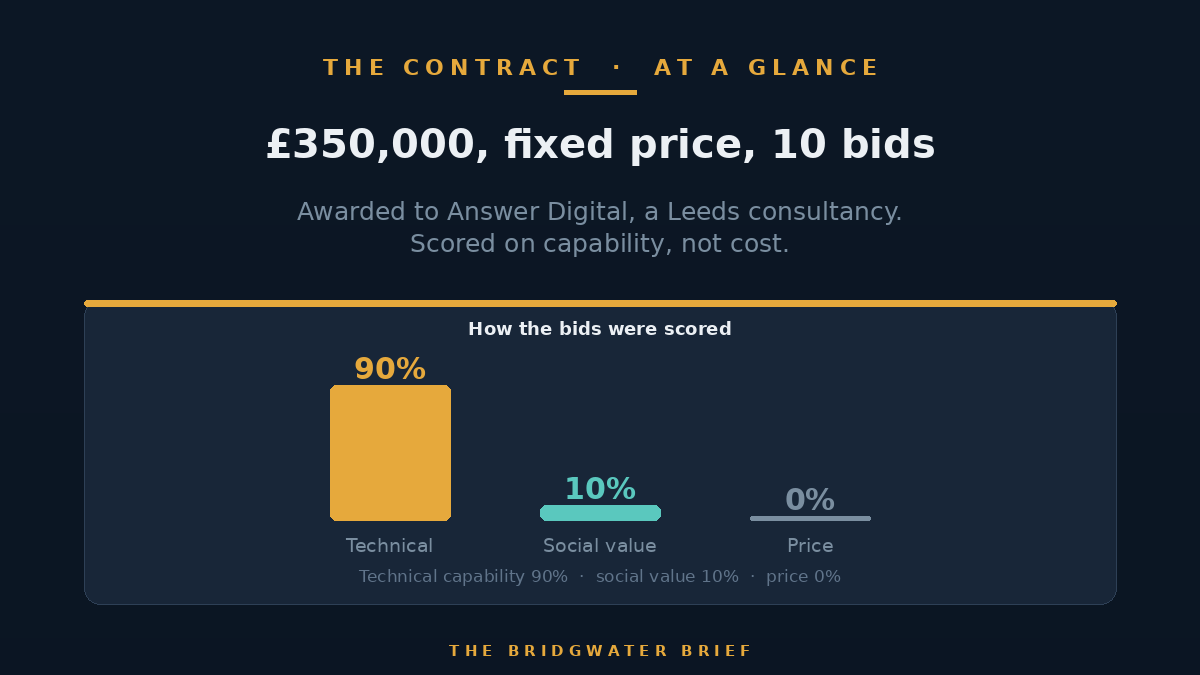
A few details are worth drawing out. The contract is a fixed-price £350,000 with no options, awarded through a restricted procedure that attracted ten electronic bids. The scoring is the tell on priorities: technical capability was weighted at 90 per cent and social value at 10 per cent, with price scored at zero. In other words, the TRA chose on capability, not cost. The supplier, Answer Digital, is an established Leeds digital and data consultancy with a public-sector and healthcare track record and a stated AI practice. The work is based in Reading, where the TRA sits.
What it does not buy – and why that matters
It is as important to say what this is not. The notice does not describe an AI system that will weigh evidence or set duties. It describes a discovery phase and a prototype. It names no model, no vendor tool, and no specific technique. "Artificial Intelligence" appears in the contract's title and lot, but the scope on the page is a capability review and a proof of concept.
That gap matters because of where the work sits. Trade-remedy investigations are quasi-judicial: they assess competing evidence, apply legal tests, and produce findings that move money across whole sectors. Automation that merely sorts documents or flags anomalies is low-stakes. Automation that starts to shape the analysis an investigator relies on is not. Nothing in the notice says the TRA intends the latter, but nothing rules it out either, and the public record is silent on how any tool would be used, tested, or checked.
The transparency question
This is where a UK rule is supposed to help. The government's Algorithmic Transparency Recording Standard (ATRS) asks public bodies to publish a record describing algorithmic tools that play a significant role in decisions affecting the public. The standard's own purpose is to make the use of such tools "transparent and understandable". The government made the standard mandatory for central government departments in early 2024, and a later scope and exemptions policy extended it to many of their arm’s-length bodies.
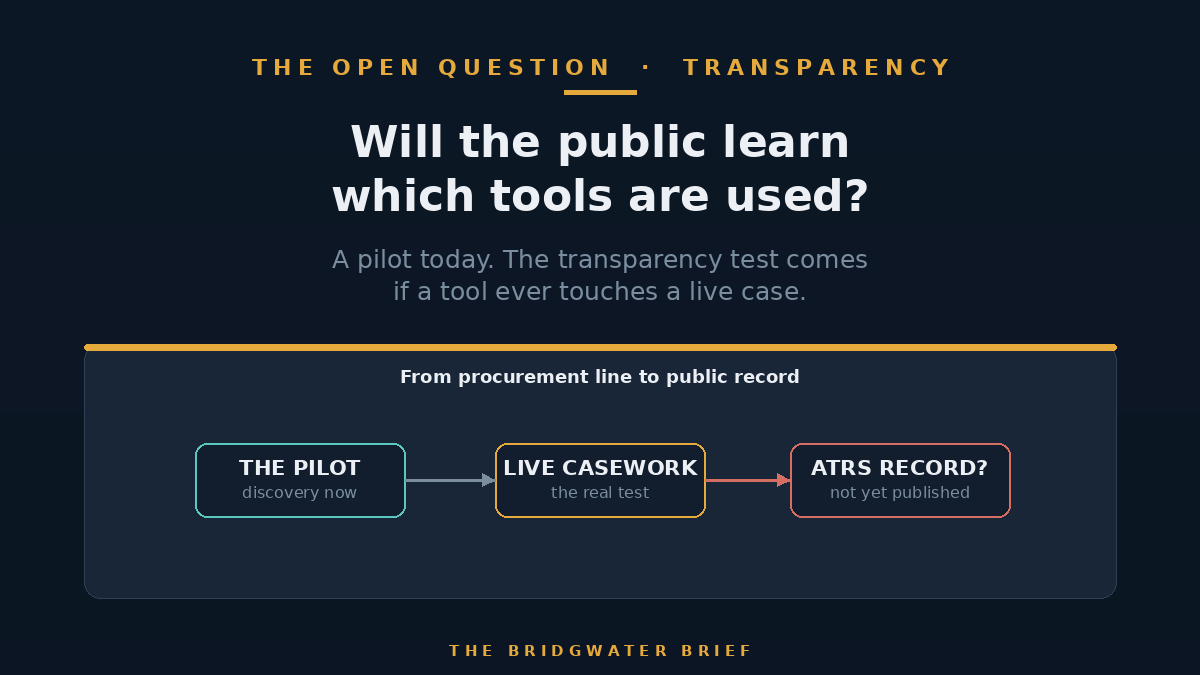
Whether the TRA falls squarely inside that mandatory scope as an arm's-length body, and whether a discovery-and-prototype pilot would trigger a record before anything is deployed, are genuinely open questions. The honest point for readers is simpler: the moment any of this moves from prototype to something that touches live casework, the ATRS entry is the document that should tell the public what tool is being used and how. Right now, the procurement notice is the only public trace, and it does not answer those questions.
The TRA is not unusual here. UK regulators and agencies are steadily bringing AI in-house: the Office of Rail and Road, which helped write guidance on AI in its sector, is tendering for AI agents of its own, and the Insolvency Service has hired a UK AI firm to map financial-crime networks. The pattern is consistent: the tools arrive through procurement long before they arrive in public explanation.
FAQ
Is the Trade Remedies Authority using AI to set tariffs?
No. The contract funds a discovery exercise and a prototype to see where automation and AI could help its casework. It does not describe an AI system that decides or recommends duties, and tariff decisions remain with investigators and, ultimately, ministers.
How much is being spent, and with whom?
£350,000, fixed price, awarded to the Leeds consultancy Answer Digital after a competitive process with ten bids, according to the Find a Tender award notice.
Will the public be told which AI tools the TRA uses?
That is the open question. The Algorithmic Transparency Recording Standard is designed to require exactly that kind of disclosure for significant tools, but it is not yet clear whether this early-stage pilot triggers a record. For now the procurement notice is the only public detail, and it names no tool.
Why does a trade regulator's IT project matter?
Because trade-remedy findings move duties across whole sectors, from steel to chemicals, and those costs reach UK businesses and buyers. How evidence is handled in that casework is a public-interest question, not just an internal efficiency one.
The takeaway
A £350,000 pilot is small money and early-stage work, and it would be easy to wave past. The reason to notice it is the direction of travel: automation is moving into the parts of the state that make contested, consequential calls, and it is arriving first as a line in a procurement feed. The TRA's pilot may turn out to be a sensible tidy-up of a paperwork-heavy process. The test will be whether, if it grows into something that touches live casework, the public learns what the tool is and how it is checked – rather than having to read it off a tender notice.
Sources
- Find a Tender – Automation and Artificial Intelligence Discovery and Pilot, contract award notice 104762-2026 (4 November 2026)
- GOV.UK – Trade Remedies Authority (organisation page)
- GOV.UK – Algorithmic Transparency Recording Standard: mandatory scope and exemptions policy
- GOV.UK – Algorithmic Transparency Recording Standard hub
- The Bridgwater Brief – The rail regulator that wrote the AI rulebook is tendering for AI agents of its own
- The Bridgwater Brief – The Insolvency Service has hired UK AI firm Quantexa to map financial-crime networks