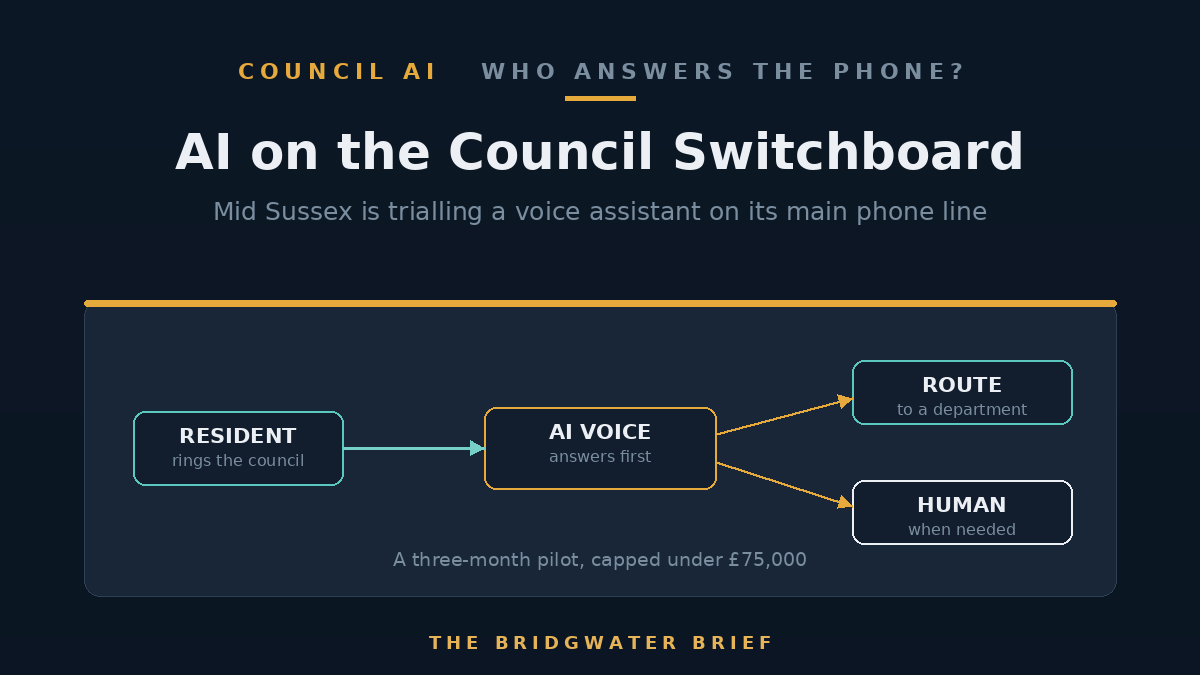
Mid Sussex District Council has awarded a contract to put an artificial-intelligence voice assistant on its main switchboard, according to a public tender notice published on 16 November 2026. The three-month pilot lets a Salford-based firm, Absolute Intelligence Call Centre Ltd, run an AI system that answers and routes calls to the West Sussex council. It was awarded through a closed quotation among four suppliers, is worth £74,999 excluding VAT (£89,998.80 with VAT) with the final cost depending on usage, and runs from 11 November 2026 to 10 February 2027. This is a small, time-limited trial rather than a permanent switch, but it is another sign that the voice on the end of a council phone line is increasingly likely to be a machine.
This piece reflects the public procurement record as of November 2026. The figures come from the councils' own Find a Tender notices, read on 16 November 2026; notices can be updated after publication.
What Mid Sussex has actually bought
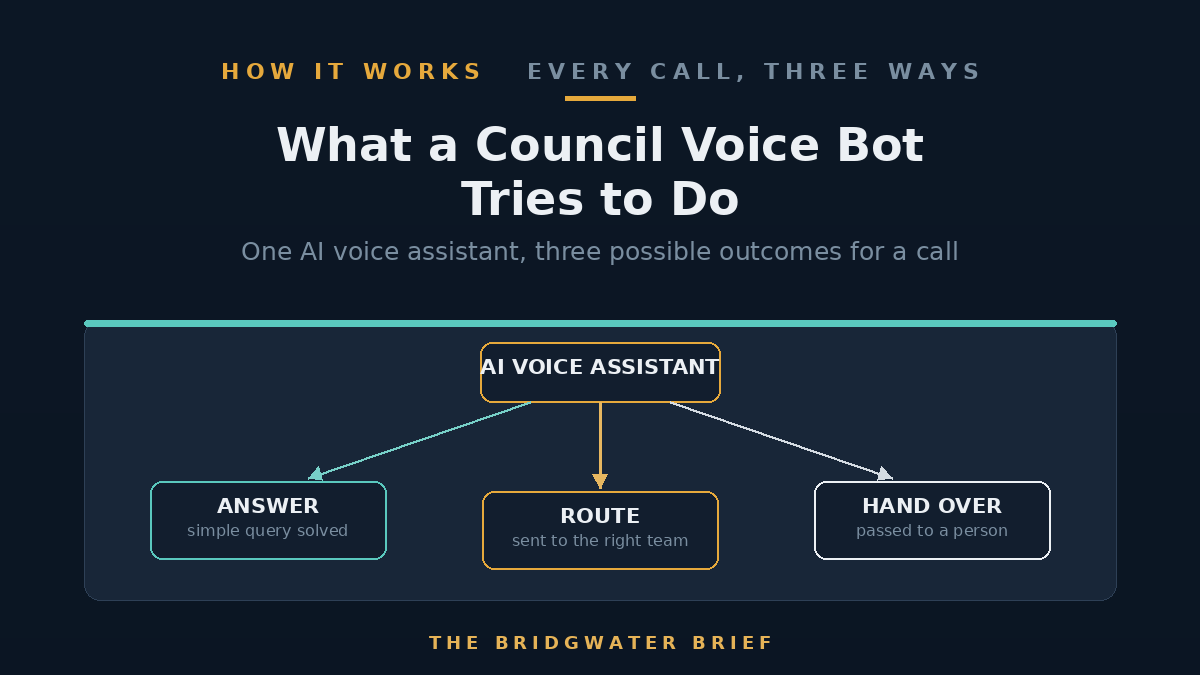
The notice describes an award, not a plan: the council has chosen a supplier and signed. The scope is narrow and specific. The AI will sit on the council's main switchboard number, the single line most residents ring when they do not know which department they need. The supplier, Absolute Intelligence Call Centre Ltd, is a Greater Manchester small business, and the deal was done through a "below threshold, limited competition" process, meaning an invited contest rather than an open tender. The stated term is three months, which marks this out as a pilot rather than a settled piece of infrastructure.
The money is worth reading carefully. The value is usage-dependent and recorded at £74,999 excluding VAT (£89,998.80 with VAT), which the notice flags as below the relevant procurement threshold. That sits just under £75,000, a common line below which public bodies can use a lighter-touch, closed procurement rather than a full open tender. Pricing a short pilot just under that line is routine and not improper in itself, but it should be said plainly: this was a limited competition among four invited suppliers, not an open contest, and the figure is a usage-dependent cap, not a sum the council has committed to spend.
Why councils are putting AI on the phones
Mid Sussex is not doing anything unusual. A growing number of UK councils have bought or trialled AI phone and voice systems over the past two years, and the pitch to them is consistent: automate the high volume of simple, repetitive calls (bin days, council tax questions, address changes) so that human staff can spend longer on the complicated cases. Derby City Council was promoted by its supplier as running what was billed as the first generative-AI phone assistant in the UK public sector, a "UK first" claim that comes from the vendor rather than an independent audit. Closer to Mid Sussex, the neighbouring Sussex authorities of Lewes and Eastbourne have deployed a council AI assistant from the same supplier, and other firms sell similar voice tools into local government. The shift is not confined to councils: central government has signed a £9m deal with ElevenLabs to give its services an AI voice, and an AI already answers the phone at around 150 NHS GP surgeries.
The driver is money and staffing. Council customer-service teams field enormous call volumes, and suppliers advertise large reductions in the share of calls that reach a human. Those figures are supplier-reported and measured in ways that suit the sales pitch, so they should be treated as marketing rather than evidence. What is not in dispute is the direction of travel: for routine enquiries, more councils want a machine to pick up first.
The honest questions a pilot like this raises
Call deflection is not the same as a problem solved. A system that stops a call reaching a human has "deflected" it whether the resident got what they needed or gave up. The measure that matters to residents is whether their issue was resolved, and that is harder to count and rarely the headline number.
There is also the question of who rings the council. Local-authority switchboards carry a disproportionate share of older, vulnerable and digitally excluded callers, the people least likely to have used a web form and most likely to need a patient human. A voice bot that handles a confident caller well can still fail someone who is distressed, hard to understand, or asking about something sensitive such as housing or care. A pilot's quality depends heavily on how easily, and how quickly, a caller can reach a person, and the notice does not spell that out.
Accuracy is the third concern. An AI that invents a bin-collection date or misstates a council-tax rule creates work rather than saving it, and council information is exactly the kind of detailed, local, frequently changing content that general-purpose language models get wrong. A three-month pilot is a reasonable way to test all of this before committing, provided the council measures resolution and complaints, not just deflection, and is willing to walk away.
Not just the phones: a busy day on the council AI register
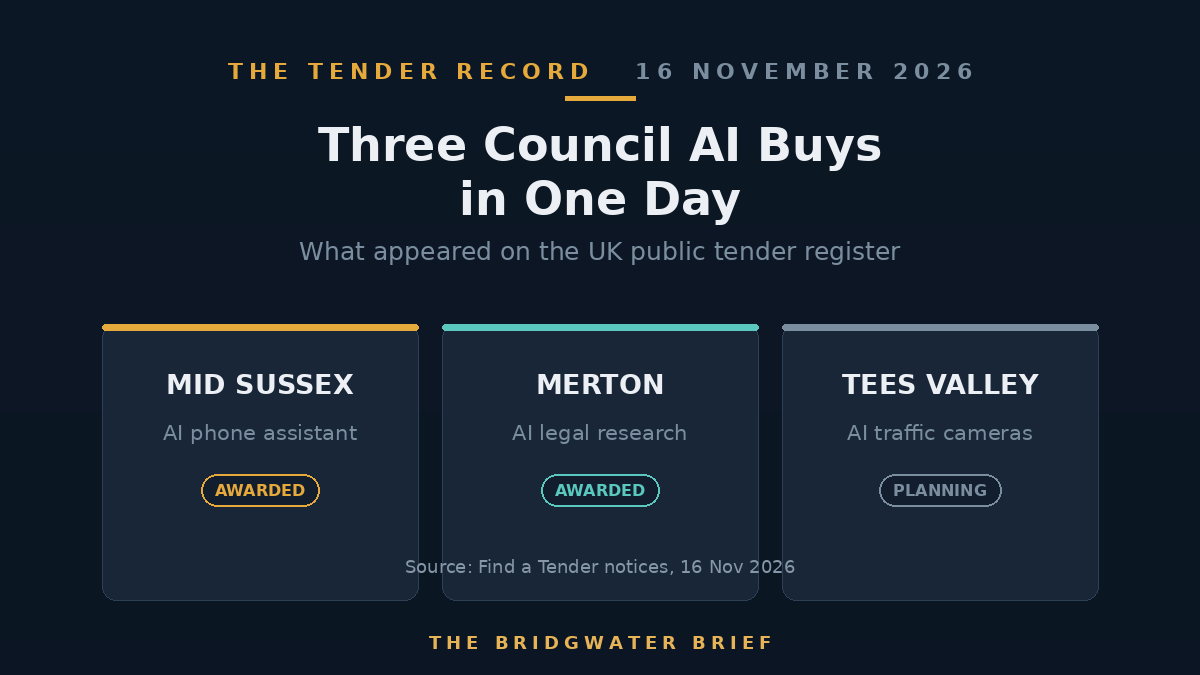
The Mid Sussex award did not appear in isolation. The same public tender register carried two other, larger council AI procurements on 16 November 2026. The London Borough of Merton made a direct award to Thomson Reuters, worth £302,781 excluding VAT over two years, for an AI research module for the South London Legal Partnership, the shared legal service it runs with neighbouring boroughs. A direct award means no competitive tender, which is permitted in defined circumstances but is worth noting when the thing being bought is a new AI capability. Tees Valley Combined Authority, meanwhile, published a pipeline notice for "Computer Vision Detection", AI video analytics to read traffic-camera footage for congestion and incidents, with an estimated value of £3m and a formal tender expected around 1 December 2026. That one has no supplier or contract yet, so it signals intent rather than a done deal.
Read together, the three notices are a useful snapshot: in a single day, three different UK local authorities moved on AI across three very different functions, answering the phone (a £75,000 pilot), legal research (a £302,781 direct award) and watching the roads (a planned procurement estimated at £3m). None of it is dramatic on its own. The pattern is the story.
FAQ
Will a robot answer when I call Mid Sussex?
During the pilot, some calls to the main switchboard may be answered or routed by an AI voice assistant rather than a person. The notice does not say whether every call is handled this way, or how a caller reaches a human, and the council has not published those details.
How much is it costing?
The contract is worth £74,999 excluding VAT (£89,998.80 with VAT) and is charged by usage, so the actual cost depends on how many calls the system handles over the three months. The figure is a cap rather than a committed spend.
Which company is providing it?
The notice names the supplier as Absolute Intelligence Call Centre Ltd, a Salford-based small business. The council chose it through a closed quotation among four invited suppliers rather than an open tender.
Is this the first council to do it?
No. A number of UK councils and public bodies have already brought in AI for resident-facing work: Newcastle is using an AI chatbot to handle parking-ticket appeals and Warwickshire has signed a council-wide AI deal, among others. Putting AI specifically on the phone line, as Mid Sussex is doing, is a recent example of that trend, not the first mover.
The takeaway
On its own, a three-month, sub-£75,000 pilot at one district council is minor news. As a marker, it matters: ringing the council is one of the most common ways people deal with local government, and that interaction is quietly being handed, in part, to AI. A pilot is the right way to test it, but the test only means something if the council judges it on whether residents' problems get solved and whether the people who most need a human can still reach one, rather than on how many calls it kept away from staff. The procurement record will show whether this one is extended or dropped.
Sources
- Find a Tender – Mid Sussex District Council AI Voice Assistant Pilot award notice (16 November 2026)
- Find a Tender – London Borough of Merton, Online Legal Research Services, direct award to Thomson Reuters for the SLLP AI research module (16 November 2026)
- Find a Tender – Tees Valley Combined Authority, Computer Vision Detection pipeline notice (16 November 2026)
- Technology Record – Derby City Council generative-AI phone assistant with ICS.AI (vendor-sourced "UK first" claim)
- The Bridgwater Brief – the UK's £9m ElevenLabs deal to give government an AI voice
- The Bridgwater Brief – an AI now answers the phone at around 150 NHS GP surgeries
- The Bridgwater Brief – Newcastle's AI chatbot for parking-ticket appeals
- The Bridgwater Brief – Warwickshire's council-wide AI deal